How staking rewards actually work: what the beginner guides skip
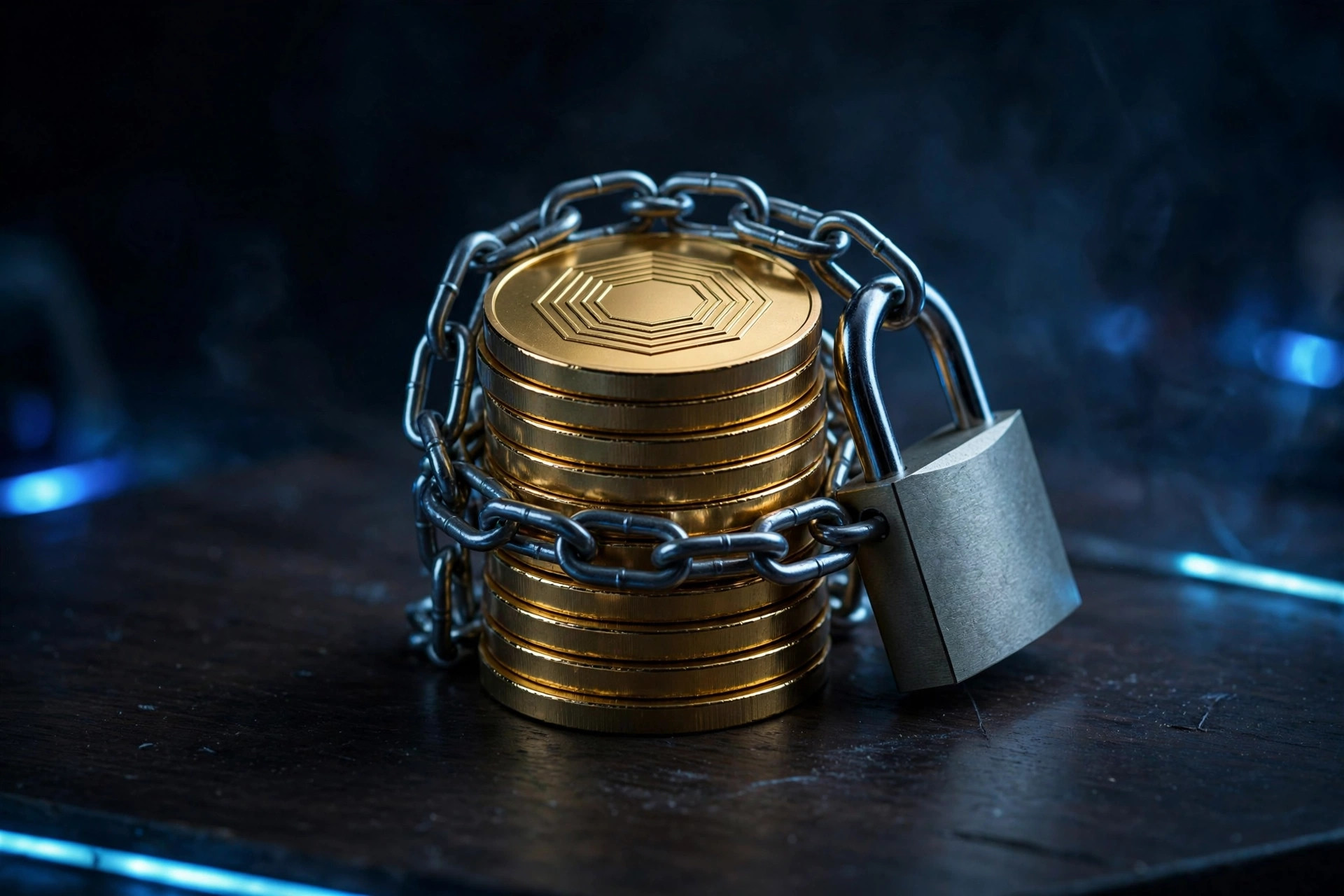
Most staking explainers read like a pitch: lock up your coins, earn rewards, sit back. The mechanics they describe are real — staking does pay rewards on certain blockchains — but the pitch skips the two parts that actually determine whether staking works out for a beginner: what lock-in costs you when prices fall, and what "rewards" mean when they're paid in the same volatile asset you're staking. This guide covers the parts the savings-account analogies leave out.
How staking pays you, in one paragraph
Staking only exists on blockchains that use proof-of-stake consensus. Participants lock up ("stake") tokens so the network can select them to validate transactions and add new blocks. The stake is the validator's "skin in the game": it makes dishonest behavior expensive, because misbehaving validators can be penalized — a penalty called slashing that has happened on networks including Polkadot and Ethereum. In exchange for committing their tokens, validators receive rewards denominated in the network's native cryptocurrency. Ethereum moved from mining to proof-of-stake, which is why staking is available on it today.
The savings-account analogy — and where it breaks
Beginner guides love comparing staking to a savings account. The comparison survives exactly one sentence: you commit funds and get paid for it. After that, it breaks in ways that matter.
First, savings interest is denominated in dollars and owed by a bank. Staking rewards are variable — not guaranteed — and are paid in the same cryptocurrency you staked. A bank can't pay your interest in a currency that loses 30% of its value overnight; a staking protocol does exactly that, routinely.
Second, bank deposits are insured and liquid. Staked tokens are typically not available for use or transfer during the staking period, and even when you decide to exit, unstaking may not be immediate — some networks require a minimum staking period. Your "savings" can be temporarily inaccessible at exactly the moment you'd most want to reach them.
What lock-in actually costs when prices fall
Here's the arithmetic the pitch skips. Take a purely illustrative example (hypothetical numbers only, not real yields or predictions): you stake $1,000 of a token earning a 6% reward. Over the year you collect $60 in rewards — paid in the token itself. But if the token's price falls 40% during that year, your $1,000 stake is worth $600 and your $60 of rewards is worth $36. You earned rewards and still lost roughly $364.
The reward rate tells you almost nothing about the outcome; the asset's price does. Staking doesn't change the fundamental risk of holding a volatile asset — it just adds a small income stream on top of it, while removing your ability to sell during part of the ride. If you wouldn't hold the token for a year without staking, staking rewards are not a reason to hold it.
The three participation routes, compared honestly
You don't need to run network infrastructure to stake. There are three routes, and the trade-off is always convenience versus control versus yield:
| Route | How it works | The catch |
|---|---|---|
| Exchange staking | A centralized exchange stakes for you; you click a button. | Simplest option, but the yield is slightly lower than other routes, and your coins sit on someone else's platform. |
| Delegating to a validator | You delegate your coins to a node operator who does the technical work. | You earn yield without the technical burden, but you take on the added risk of picking an operator that behaves honestly and won't get your stake slashed. |
| Running your own node | You operate validator software directly and contribute to the chain's security. | Potentially the highest yield, but technically demanding — and mistakes can cost you. |
Note the asymmetry: the simplest route adds platform risk, the middle route adds operator risk, and the hardest route adds your own-error risk. None of the three removes price risk. Also note that staking isn't available on every coin — Bitcoin and Dogecoin, for example, run on proof-of-work and cannot be staked at all.
A should-I-stake decision checklist
Run through these five questions before staking anything:
- Would I hold this asset for a year without any rewards? If no, staking is not the fix — it's the same volatile asset with a small yield attached.
- Can I afford to not touch this money for the lock-in period? If a price crash would make you want to sell, remember: staked tokens are typically unavailable, and unstaking isn't instant.
- Do I understand the slashing risk of my chosen route? Penalties are rare but real — they've occurred on major networks.
- Am I comparing yields honestly? A 6% reward in a token that drops 40% is not 6%. Always price the reward in the currency you actually spend.
- Would the exchange/platform survive a bad year? If you stake through a platform, you're trusting it with custody on top of everything else.
If any answer is "no" or "I don't know," the honest move is to learn more before committing funds — not to chase the highest advertised rate.
FAQ
Is staking risk-free income? No. Rewards are variable and not guaranteed, the staked asset can fall in value, validators can be slashed, and locked tokens can't be sold during drawdowns. It's income with layered risk, not free income.
Can you lose money staking? Yes — through the token's price falling, through slashing penalties on the validator you're using, or through the platform holding your stake failing. The reward rate never compensates for a large price drop.
Which cryptocurrencies can be staked? Only ones running proof-of-stake. Ethereum is the largest example; Bitcoin and Dogecoin use proof-of-work and cannot be staked. Check the specific network's documentation before assuming.
Crypto Investing is educational content only, not financial advice. Crypto assets are volatile and can lose all value.